

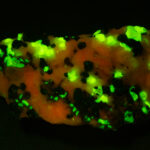
Fluorescence vs Phosphorescence – a Photographic Investigation
Using photography to document an interesting case of fluorescence vs phosporescence.
read more »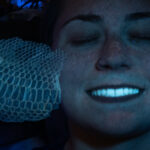
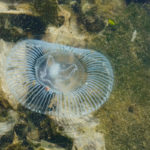
The Jellyfish that Won the Nobel Prize
The jellyfish Aequorea was the source of a discovery that led to one of the most significant advances in biological imaging ever – green fluorescent protein (GFP).
read more »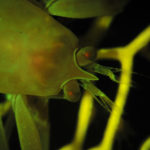
Fluorescence of Deep Sea Corals of the Phoenix Island Protected Area (PIPA)
NIGHTSEA recently collaborated with professor Randi Rotjan of Boston University on her work with the Schmidt Ocean Institute mission aimed at studying deep sea corals growing on seamounts within “PIPA.”
read more »
The Case of the Fluorescent Fibers
We investigated the source of individual, brightly fluorescing fibers found on ordinary towels and washcloths.
read more »Marine Fluorescence Imaging at the Monterey Bay Aquarium
From NIGHTSEA founder Charles Mazel In August 2017 I was in Monterey, CA, on vacation and of course visited the wonderful Monterey Bay Aquarium. While there I connected with Jim Covel, Director of Guest Experience, Training, and Interpretation. After a brief conversation about fluorescence of marine organisms Jim invited me to return later that day […]
read more »Mineral Fluorescence Under Blue Light
The geology community knows a lot about mineral fluorescence under excitation by various wavelengths of ultraviolet light but when it comes to excitation by light in the visible portion of the spectrum, such as blue, … not so much.
read more »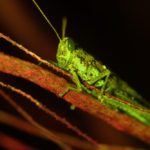
Insect Fluorescence in the Wild
A fun evening jaunt to search for fluorescing insects in Ocala National Forest, Florida.
read more »Fluorescent Life in Seaweed
On a recent trip to Cape Cod I grabbed a random sample of seaweed floating by the shore in Quisset Harbor. Just enough to not overfill a plastic take-out food container. I took it back to my stereo microscope fitted with our fluorescence adapter. Wow! The diversity of life was phenomenal for this tiny little slice […]
read more »Fluorescence at the Seacoast Science Center
From NIGHTSEA founder Charles Mazel: On October 9, 2014, I gave a presentation on fluorescence in the sea at the Seacoast Science Center in Rye, NH. I wanted to include some local color in the presentation so I went up to the Center a couple of weeks in advance and explored fluorescence in three ways – (1) in the […]
read more »Fluorescence in Pacific Coast Tide Pools
Report by Dr. Charles Mazel, NIGHTSEA founder You don’t necessarily have to go underwater to enjoy the fluorescence of marine subjects. In many places you can do fluorescence exploration when the tide goes out, providing access to subjects in tide pools and on exposed rock surfaces. On a recent trip to the Monterey peninsula (California) the timing was right for low […]
read more »Life in Sand Enhanced by Fluorescence Microscopy
There is a lot more to see in a random scoop of sand than you might expect. On a trip to the Monterey peninsula (California) I collected sand from a tide pool at the north end of Asilomar State Beach and then looked at it under a stereo microscope outfitted with the NIGHTSEA Stereo Microscope Fluorescence Adapter with Royal […]
read more »Story Behind a Fluorescence Photograph
by Charles Mazel, PhD Underwater fluorescence is beautiful and widespread. It’s not hard to find photogenic subjects and you can come back with lots of striking shots on camera – especially in this digital age. But sometimes there is more of a story behind a photograph. This is one of them. The image here is […]
read more »Fluoro Diving Leads to Discovery – a Fluorescing Ostracod
by Charles Mazel, PhD – NIGHTSEA founder So there I was, underwater in the dark, chasing a fluorescing speck around with a plastic sandwich bag. It was back in 2003 and I had a research project where we set up one of the Harbor Branch Oceanographic Institution Johnson Sea-Link submersibles to conduct the first-ever deep sea explorations […]
read more »Underwater Fluorescence in the Depths of the Sea
In 2003 NIGHTSEA founder Dr. Charles Mazel had the privilege of being the Chief Scientist on the first-ever project to explore for fluorescence on the deep sea floor. The ONR-supported expedition used the Johnson Sea-Link manned submersible operated by Harbor Branch Oceanographic Institution, making a total of 18 dives to depths as great as 850 meters […]
read more »